Guest List Management
Guest List Management
Flexible guest management workflow for promoters with configurable invitation flows, delivery methods, and stakeholder-based guest lists.
Flexible guest management workflow for promoters with configurable invitation flows, delivery methods, and stakeholder-based guest lists.
Context & Problem
The project focused on redesigning the guest list workflow of a ticketing platform used by a wide range of event promoters and organizers across different types of venues and events.
The existing system only supported:
adding one guest at a time,
email-only ticket delivery,
and a single fixed invitation flow where every invitee had to go through the same attendee-information process before receiving a ticket.
This rigid structure created operational problems for promoters with very different workflows and event requirements.
In many real-world scenarios:
guests were already present at the venue and did not require ticket delivery,
promoters preferred printed tickets instead of email delivery,
attendee-information collection created unnecessary friction,
and large guest lists became extremely time-consuming to manage.
Because the system lacked flexibility, many promoters started creating manual workarounds both inside and outside the platform. In one case, a promoter created a separate 0€ sales channel and distributed the link as an invitation method simply to avoid manually entering thousands of guests through the existing workflow.
The lack of separated guest lists also created operational and organizational issues:
stakeholders could not clearly distinguish ownership of guests,
communication overhead increased,
privacy and accountability became difficult to manage,
and controlling guest contingents for different channels (e.g. Artist Guests vs Promoter Guests) was not possible.
The challenge was to redesign the workflow into a flexible and scalable guest-management system while balancing usability, technical feasibility, and operational simplicity.
The project focused on redesigning the guest list workflow of a ticketing platform used by a wide range of event promoters and organizers across different types of venues and events.
The existing system only supported:
adding one guest at a time,
email-only ticket delivery,
and a single fixed invitation flow where every invitee had to go through the same attendee-information process before receiving a ticket.
This rigid structure created operational problems for promoters with very different workflows and event requirements.
In many real-world scenarios:
guests were already present at the venue and did not require ticket delivery,
promoters preferred printed tickets instead of email delivery,
attendee-information collection created unnecessary friction,
and large guest lists became extremely time-consuming to manage.
The project focused on redesigning the guest list workflow of a ticketing platform used by a wide range of event promoters and organizers across different types of venues and events.
The existing system only supported:
adding one guest at a time,
email-only ticket delivery,
and a single fixed invitation flow where every invitee had to go through the same attendee-information process before receiving a ticket.
This rigid structure created operational problems for promoters with very different workflows and event requirements.
In many real-world scenarios:
guests were already present at the venue and did not require ticket delivery,
promoters preferred printed tickets instead of email delivery,
attendee-information collection created unnecessary friction,
and large guest lists became extremely time-consuming to manage.
Because the system lacked flexibility, many promoters started creating manual workarounds both inside and outside the platform. In one case, a promoter created a separate 0€ sales channel and distributed the link as an invitation method simply to avoid manually entering thousands of guests through the existing workflow.
The lack of separated guest lists also created operational and organizational issues:
stakeholders could not clearly distinguish ownership of guests,
communication overhead increased,
privacy and accountability became difficult to manage,
and controlling guest contingents for different channels (e.g. Artist Guests vs Promoter Guests) was not possible.
The challenge was to redesign the workflow into a flexible and scalable guest-management system while balancing usability, technical feasibility, and operational simplicity.
Because the system lacked flexibility, many promoters started creating manual workarounds both inside and outside the platform. In one case, a promoter created a separate 0€ sales channel and distributed the link as an invitation method simply to avoid manually entering thousands of guests through the existing workflow.
The lack of separated guest lists also created operational and organizational issues:
stakeholders could not clearly distinguish ownership of guests,
communication overhead increased,
privacy and accountability became difficult to manage,
and controlling guest contingents for different channels (e.g. Artist Guests vs Promoter Guests) was not possible.
The challenge was to redesign the workflow into a flexible and scalable guest-management system while balancing usability, technical feasibility, and operational simplicity.
Research & Process
The project started with:
stakeholder discussions with product, sales, and development teams,
behavioral analysis using GA4, Hotjar, and UXCam,
competitor analysis (e.g. Ticket.io),
and technical feasibility exploration based on the existing backend structure.
A major focus of the process was understanding the wide variety of promoter workflows and identifying where the rigid invitation logic created operational friction.
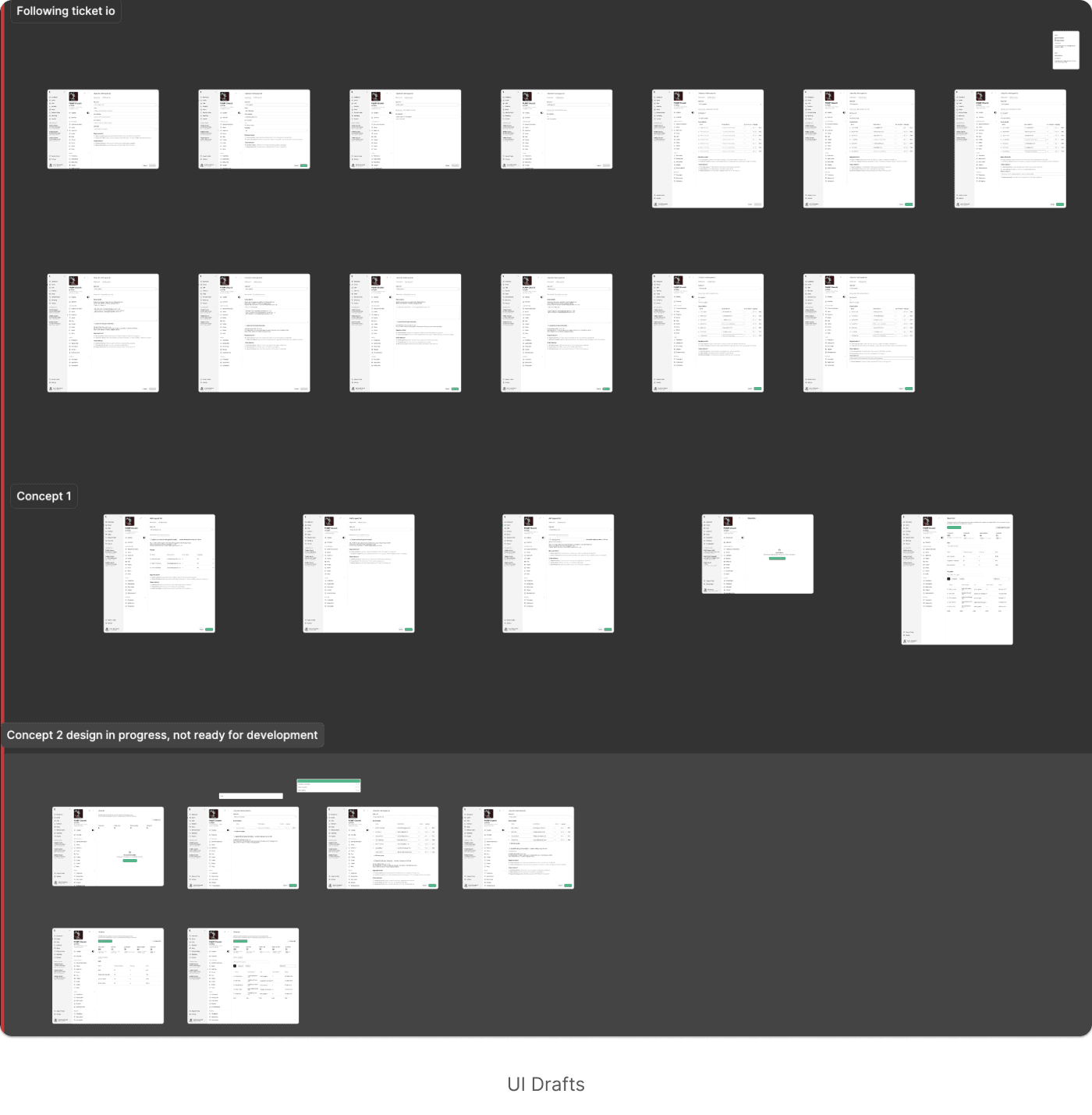
Multiple workflow variations and click prototypes were created and iterated collaboratively. Different approaches were explored for:
bulk guest entry,
configurable invitation flows,
delivery methods,
guest segmentation,
and list management.
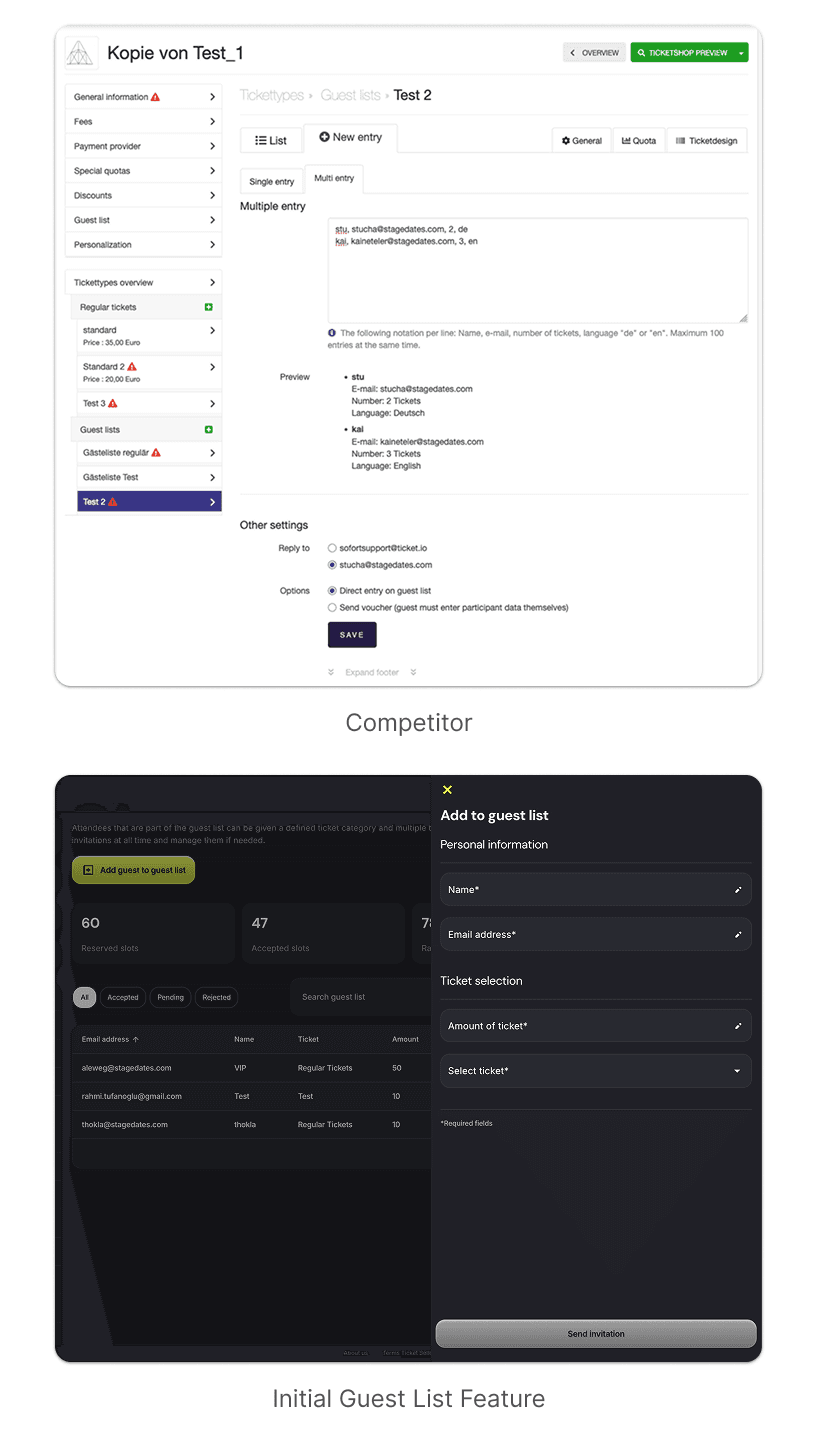
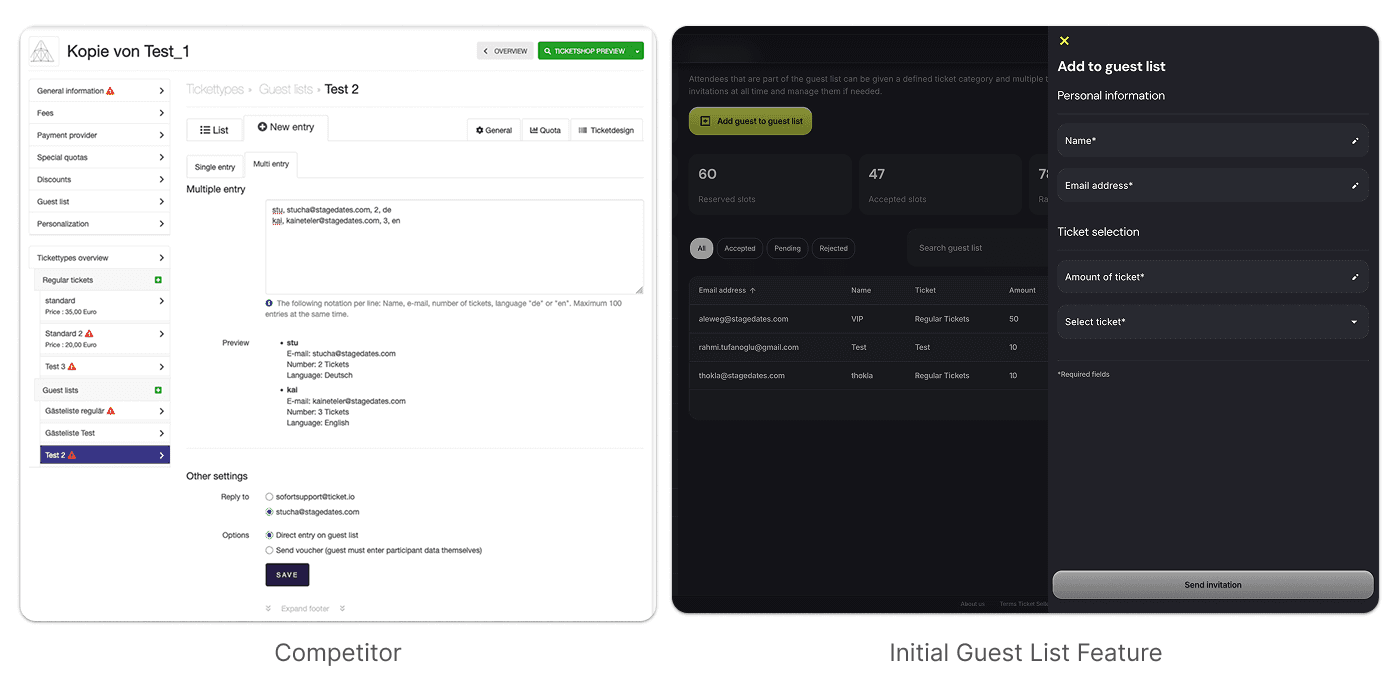
Several competitor patterns were intentionally reconsidered instead of copied directly. For example, Ticket.io used large formatted-text input for bulk guest entry, which initially appeared efficient, but introduced major usability problems for:
mobile usage,
validation,
error correction,
and navigation within large guest lists.
The project started with:
stakeholder discussions with product, sales, and development teams,
behavioral analysis using GA4, Hotjar, and UXCam,
competitor analysis (e.g. Ticket.io),
and technical feasibility exploration based on the existing backend structure.
A major focus of the process was understanding the wide variety of promoter workflows and identifying where the rigid invitation logic created operational friction.
Multiple workflow variations and click prototypes were created and iterated collaboratively. Different approaches were explored for:
bulk guest entry,
configurable invitation flows,
delivery methods,
guest segmentation,
and list management.
Several competitor patterns were intentionally reconsidered instead of copied directly. For example, Ticket.io used large formatted-text input for bulk guest entry, which initially appeared efficient, but introduced major usability problems for:
mobile usage,
validation,
error correction,
and navigation within large guest lists.
One of the hardest design challenges was balancing flexibility with simplicity. The system needed to support multiple invitation and delivery scenarios without overwhelming users with complexity. This was addressed through:
conditional UI visibility,
contextual workflows,
and combining multiple actions into a unified interface instead of forcing users into separate flows.
The process continuously balanced:
user needs,
promoter operational workflows,
backend limitations,
scalability,
and implementation effort.
One of the hardest design challenges was balancing flexibility with simplicity. The system needed to support multiple invitation and delivery scenarios without overwhelming users with complexity. This was addressed through:
conditional UI visibility,
contextual workflows,
and combining multiple actions into a unified interface instead of forcing users into separate flows.
The process continuously balanced:
user needs,
promoter operational workflows,
backend limitations,
scalability,
and implementation effort.
Final Solution
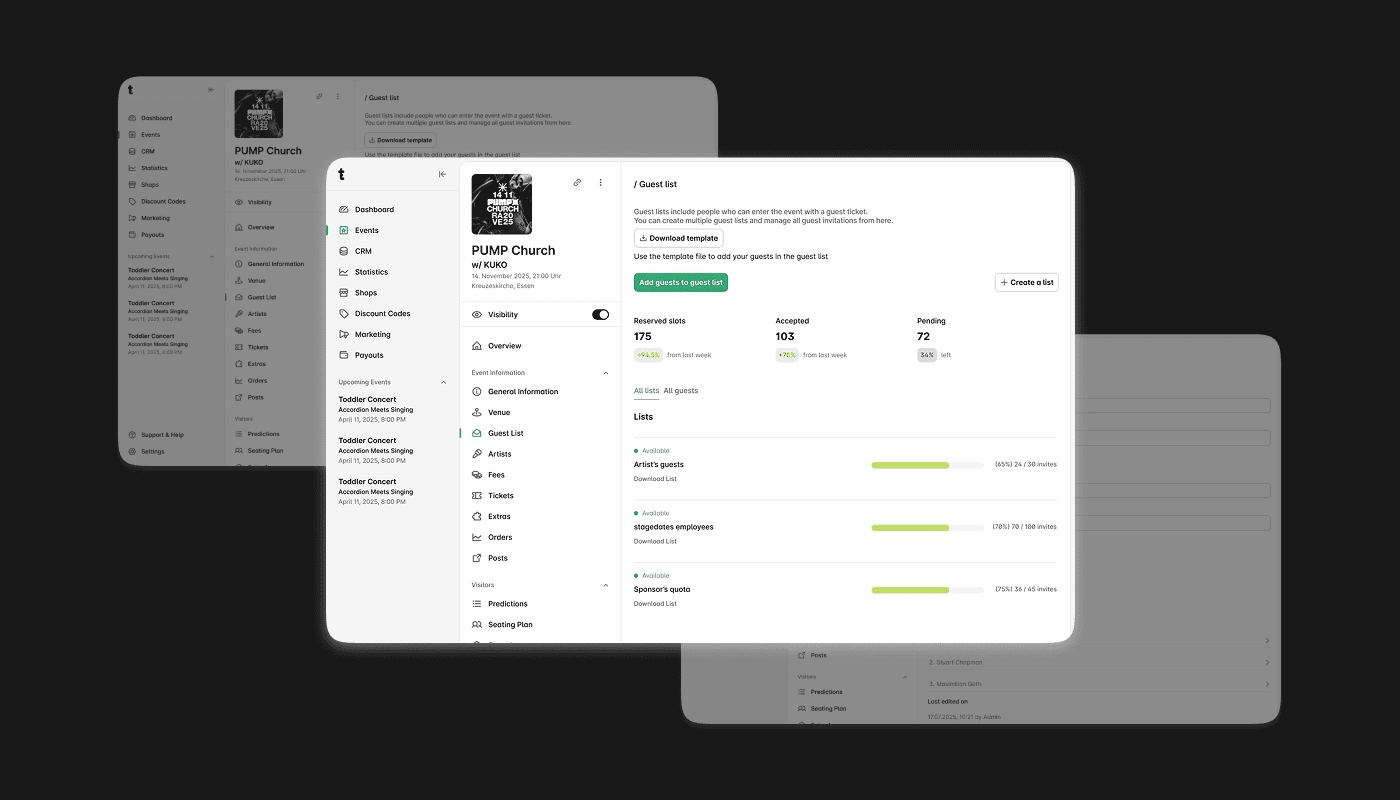
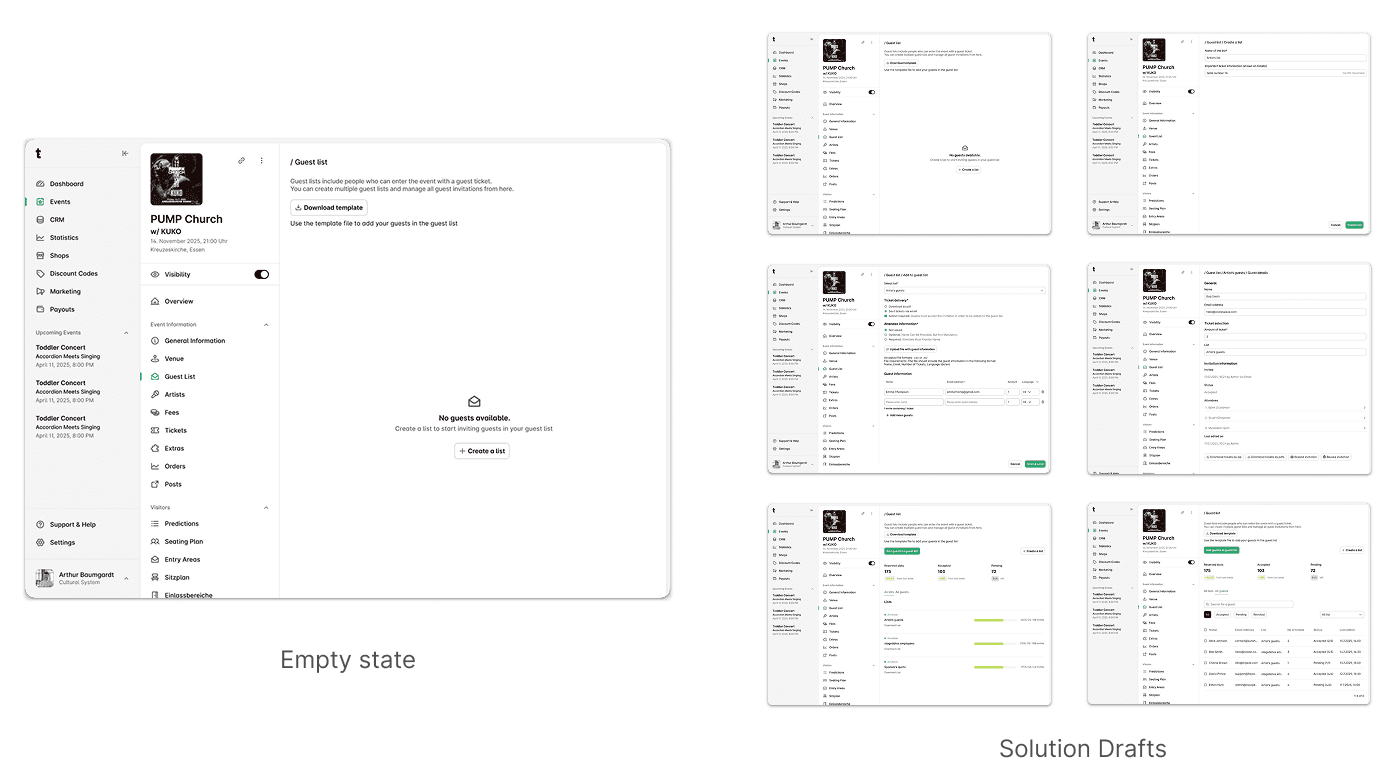
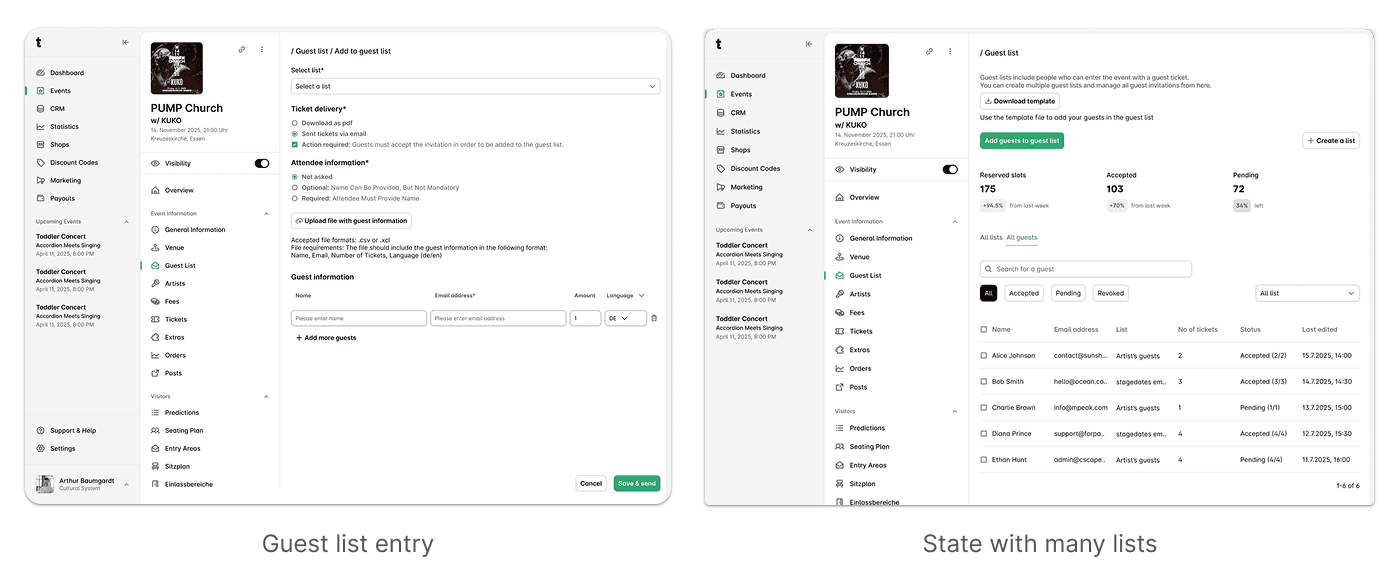
The redesigned feature introduced a flexible and scalable guest management system capable of supporting multiple operational workflows within the same interface.
Key improvements included:
Manual and CSV-based bulk guest entry
Multiple ticket delivery methods
(email delivery, PDF download, or no ticket delivery)Configurable invitation flows
(direct ticket access, invitation acceptance, attendee-information collection)Conditional UI behavior depending on workflow selection
Easier editing and clearer guest management
Multiple guest lists for different stakeholders
(Artist Guests, Promoter Guests, VIPs, etc.)
The introduction of separated guest lists improved:
ownership clarity,
privacy,
accountability,
coordination between stakeholders,
and guest contingent management.
The redesigned feature introduced a flexible and scalable guest management system capable of supporting multiple operational workflows within the same interface.
Key improvements included:
Manual and CSV-based bulk guest entry
Multiple ticket delivery methods
(email delivery, PDF download, or no ticket delivery)Configurable invitation flows
(direct ticket access, invitation acceptance, attendee-information collection)Conditional UI behavior depending on workflow selection
Easier editing and clearer guest management
Multiple guest lists for different stakeholders
(Artist Guests, Promoter Guests, VIPs, etc.)
The introduction of separated guest lists improved:
ownership clarity,
privacy,
accountability,
coordination between stakeholders,
and guest contingent management.
For example, promoters could define how many guests were allowed for different channels, helping prevent overcrowding and improving operational control during live events.
The configurable invitation logic also reduced friction significantly by allowing promoters to adapt the workflow to their actual operational needs:
simple direct invites,
marketing-focused attendee collection,
printed ticket workflows,
or no-ticket guest admission.
Instead of forcing users to learn multiple systems, the solution unified these workflows into one scalable structure.
For example, promoters could define how many guests were allowed for different channels, helping prevent overcrowding and improving operational control during live events.
The configurable invitation logic also reduced friction significantly by allowing promoters to adapt the workflow to their actual operational needs:
simple direct invites,
marketing-focused attendee collection,
printed ticket workflows,
or no-ticket guest admission.
Instead of forcing users to learn multiple systems, the solution unified these workflows into one scalable structure.

My Role & Learning
My Role
Conducted competitive and behavioral analysis using GA4, UXCam, and Hotjar
Identified operational pain points and workflow bottlenecks
Created click prototypes and explored multiple workflow variations
Collaborated closely with product owners, technical leads, developers, and sales teams
Explored technical feasibility and scalability constraints
Helped balance user needs, promoter workflows, backend limitations, and implementation effort
Iterated on interaction logic, workflow structure, and conditional UI behavior
A major part of my contribution involved simplifying highly flexible workflows into a system that remained scalable without overwhelming users with unnecessary complexity.
My Role
Conducted competitive and behavioral analysis using GA4, UXCam, and Hotjar
Identified operational pain points and workflow bottlenecks
Created click prototypes and explored multiple workflow variations
Collaborated closely with product owners, technical leads, developers, and sales teams
Explored technical feasibility and scalability constraints
Helped balance user needs, promoter workflows, backend limitations, and implementation effort
Iterated on interaction logic, workflow structure, and conditional UI behavior
A major part of my contribution involved simplifying highly flexible workflows into a system that remained scalable without overwhelming users with unnecessary complexity.
Learnings
Earlier workshop-style collaboration between business, product, and technical teams could improve alignment and reduce iterations
Large workflow changes are easier for users to adopt through gradual releases
Competitor solutions should be evaluated critically rather than copied directly
Some structural complexity can improve scalability and operational clarity for the majority of users
Flexible operational systems require careful balancing between configurability, usability, and implementation feasibility
The project reinforced the importance of designing operational UX systems around real user workflows rather than forcing all users into a single rigid process.
Learnings
Earlier workshop-style collaboration between business, product, and technical teams could improve alignment and reduce iterations
Large workflow changes are easier for users to adopt through gradual releases
Competitor solutions should be evaluated critically rather than copied directly
Some structural complexity can improve scalability and operational clarity for the majority of users
Flexible operational systems require careful balancing between configurability, usability, and implementation feasibility
The project reinforced the importance of designing operational UX systems around real user workflows rather than forcing all users into a single rigid process.